Why We Built Platform 3.0:
Six Answers from a Founder
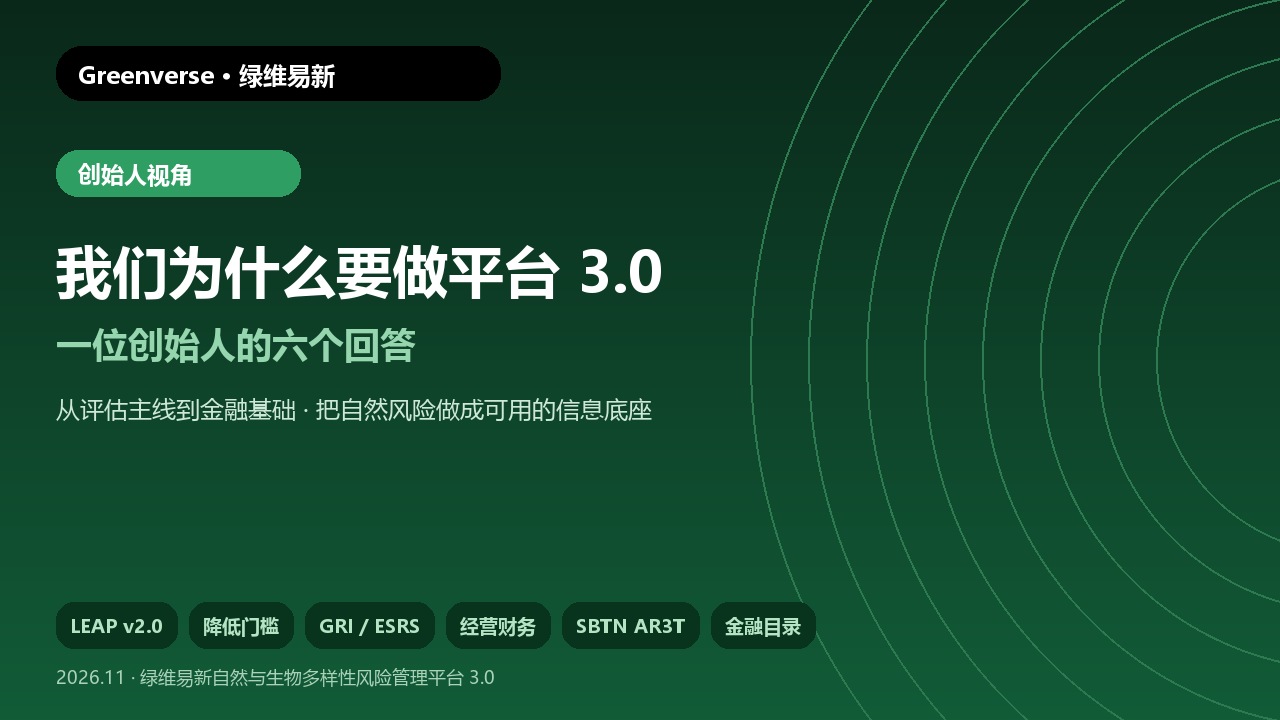
Nature-related frameworks are multiplying, but the question on the ground stays the same: where do we actually start? This is not a product launch note — it is six answers to the questions clients keep asking me.
01 | Fix the assessment spine first: LEAP v2.0
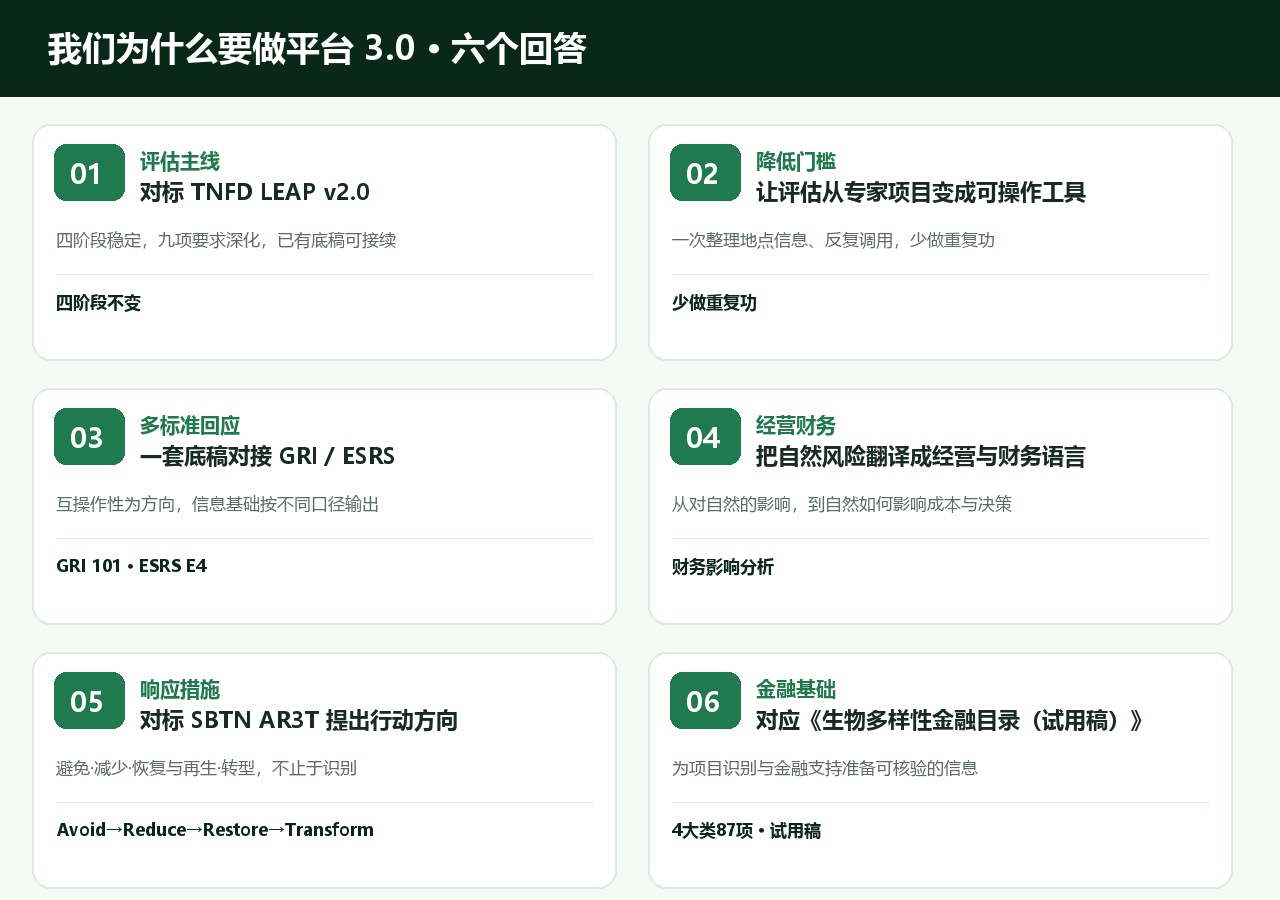
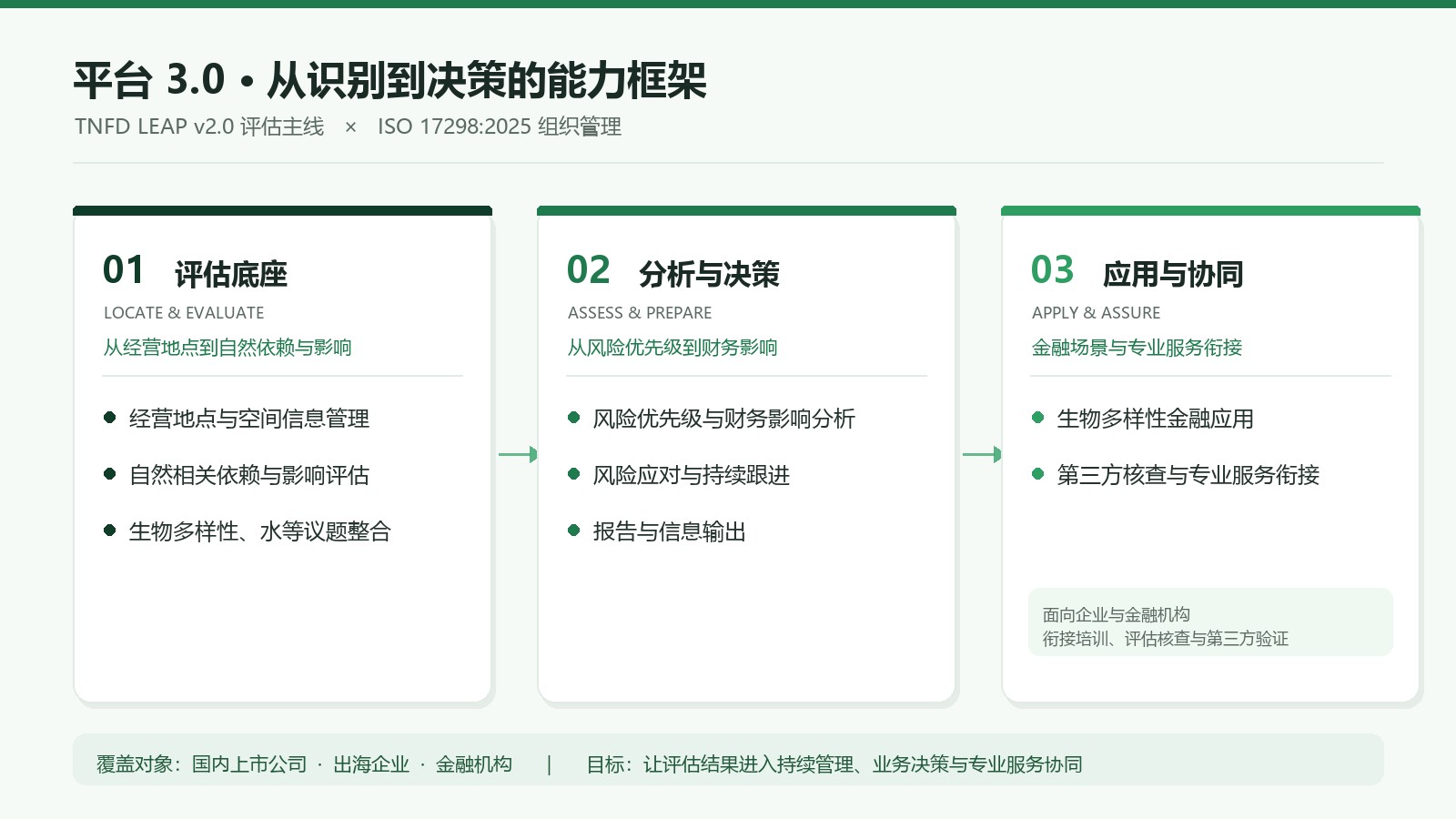
With so many frameworks, the risk is grabbing at all of them and holding none. We set TNFD's LEAP v2.0 — published in October 2026 with SBTN and NPI — as the assessment spine of Platform 3.0. The practical reason: the four phases (Locate, Evaluate, Assess, Prepare) stay stable, and the change sits in the granularity of assessment. For companies that have already run a cycle, the existing working papers still hold. We did not want the platform to become yet another framework — it is more like a workbench for putting existing methods into practice.
02 | Make assessment usable: less duplication, less time
Anyone who has run an assessment knows the hard part is not producing the report. It is whether the working papers still earn their keep afterwards. Platform 3.0 is built to cut duplication: site and spatial information, nature dependencies and impacts are organised once into a reusable foundation, then called on for internal management, reporting, finance applications or third-party verification. The barrier comes down not by lowering professional standards, but by letting the same work be used again and again.
03 | One foundation, many standards
Almost every client asks: do you align with GRI and ESRS? Our answer is that we provide the information foundation. GRI 101: Biodiversity 2024 took effect on 1 January 2026; ESRS E4 requires disclosure of biodiversity and ecosystem impacts, dependencies and risks; TNFD and GRI published an interoperability mapping in 2024. These standards have different architectures and different logic — saying one report "satisfies all of them" would be neither honest nor professional. The direction is interoperability, not replacing anyone's compliance judgement.
04 | Translate nature risk into business and financial language
Nature has often stayed in the environmental department's corner. But if an assessment cannot answer "what does this mean for my costs, supply chain and financial performance", it will not make it into the management meeting. Platform 3.0 combines site, sector and business information to prioritise risks and analyse their potential effects on operations, supply chains, costs and financial performance. That step also makes the work more honest — an assessment is neither a disclosure nor proof of improved ecological outcomes.
05 | AR3T: from identifying risk to responding
Once risks are identified, the next question is: what should we do? That is the question SBTN's AR3T action framework answers — Avoid, Reduce, Restore & Regenerate, Transform — built on the IFC Performance Standard 6 mitigation hierarchy and used in Step 4 (Act) of science-based target setting. The platform maps priority risks onto possible responses along those directions, connecting identification with action. One caveat: AR3T is not a checklist to work through in sequence — transformation runs throughout, and avoidance and reduction stay the priority.
06 | A basis for finance: the Biodiversity Finance Catalogue (Trial Draft)
The last question comes from financial institutions: how do I know whether a project counts as "biodiversity friendly"? In August 2025, the People's Bank of China published the Biodiversity Finance Catalogue (Trial Draft), organised as "catalogue listing + principle guidance + negative constraints" with four top-level categories and 87 economic activities, now being trialled in multiple provinces. Platform 3.0 organises company-side nature risk and activity information into working papers that can be matched to the catalogue's activity categories, providing verifiable information for project screening, risk management and opportunity identification. Restraint matters here: the catalogue is still a trial draft, and the platform makes no determination or endorsement.
In closing
The six questions add up to one thing: turning a one-off nature assessment into a reusable, decision-ready and verifiable information foundation. However good the tool, it does not replace an organisation's own recognition, audit or compliance judgement. LEAP is voluntary, the ISSB practice statement drawing on TNFD remains under consultation, and the LEAP-based ISO project is still in development. Standards will keep evolving. What we can do is keep the working papers solid — so that whatever the next version asks for, the data is still there and the work still connects.
About Greenverse
Greenverse is a Shanghai-based nature-tech and advisory company focused on ESG biodiversity and nature-related risk management. Combining frameworks such as TNFD, SBTN and ISO 17298 with AI, remote sensing and China's ecological databases, Greenverse helps companies and financial institutions identify, assess and manage nature-related risks and opportunities. greenverse.com.cn
START WITH A CONVERSATION · PLATFORM 3.0
Turn nature assessment into a foundation you can keep using
Contact the Greenverse team with your operating sites, sector and management or disclosure scenarios of interest, and map an assessment path together.
Contact us to start → Email usOr scan our WeChat Work QR code on the contact page. We only use the information you choose to share to respond to your enquiry.