From Disclosure to Credit Decisions: Greenverse Founder Nick Du at the PRI COP17 Investor Briefing
At a PRI investor briefing held during CBD COP17 in Yerevan, Greenverse Founder and CEO Nick Du shared China's emerging practice in biodiversity finance and exchanged views with representatives of global investment institutions. The discussion centred on what it takes to turn nature-related data into credit and investment decisions.
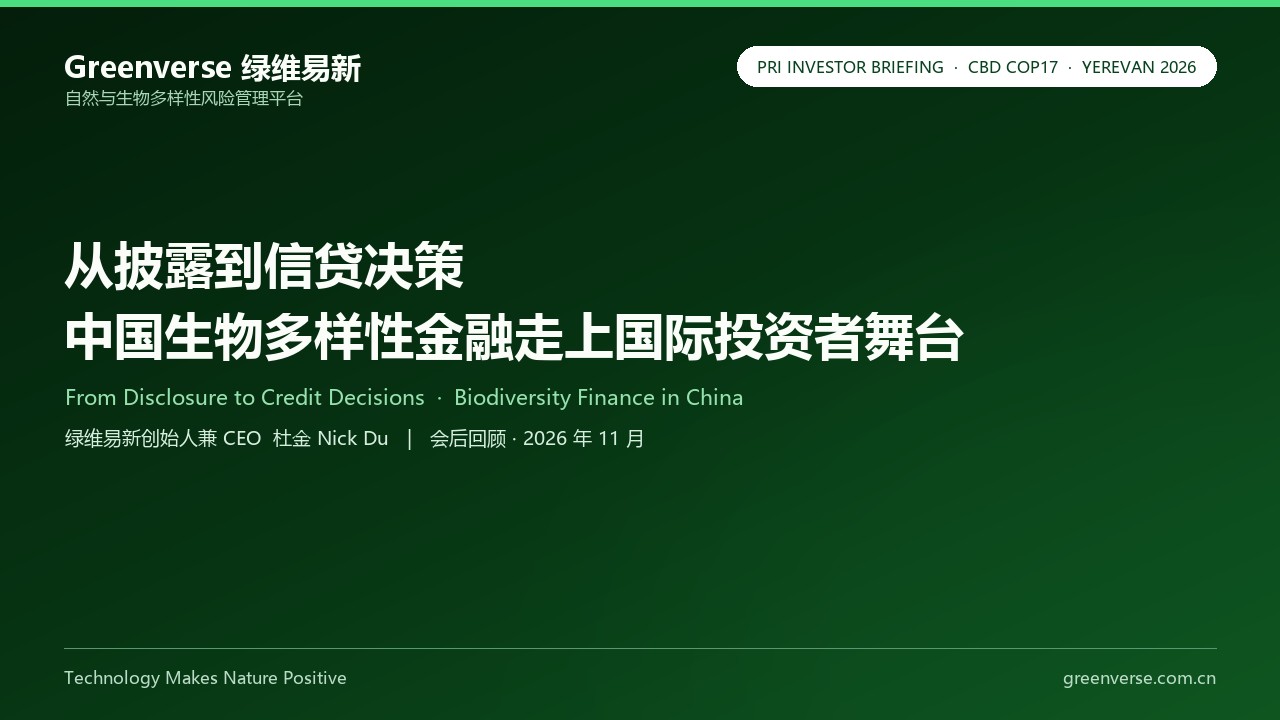
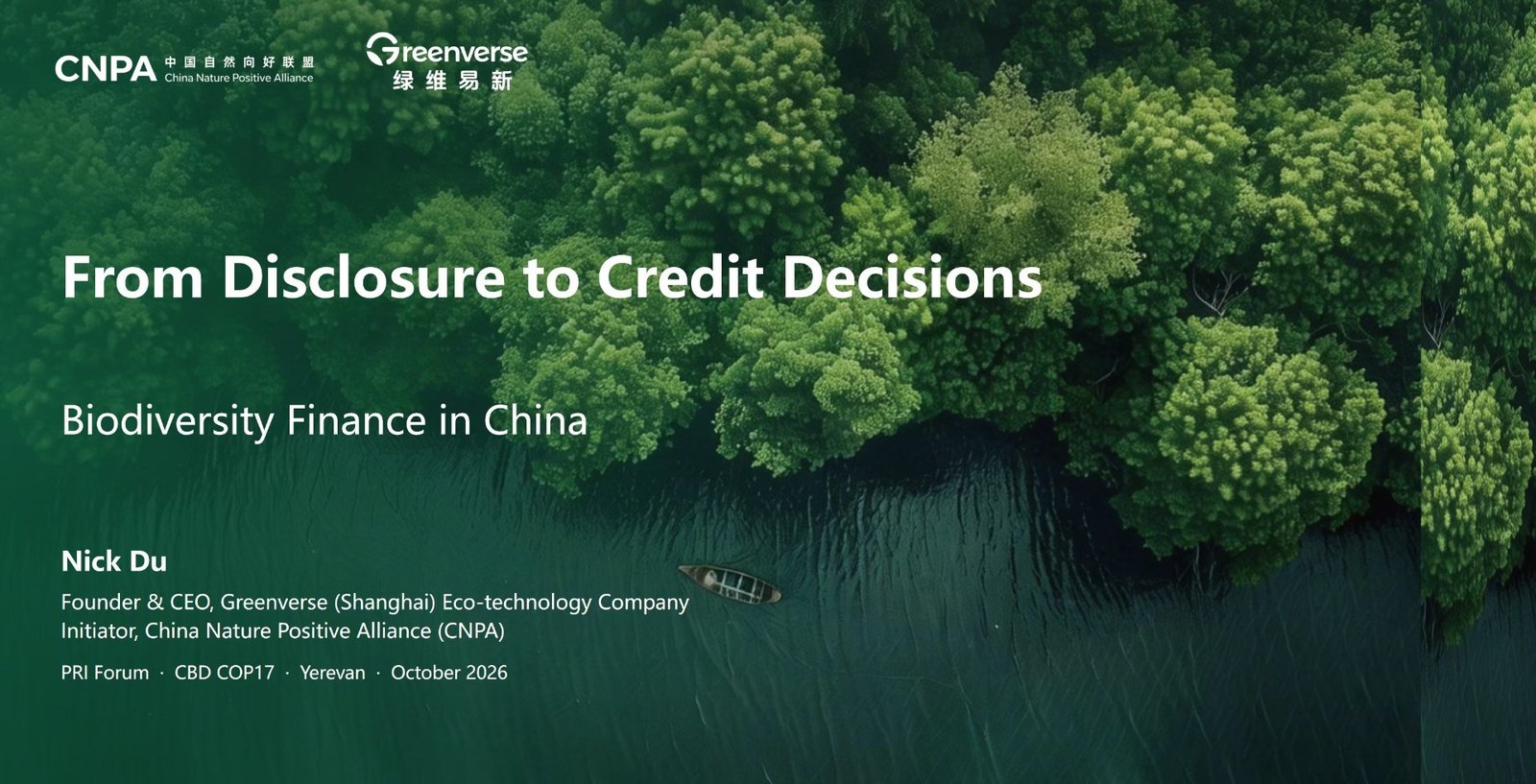
Yerevan, October 2026 — During the 17th meeting of the Conference of the Parties to the Convention on Biological Diversity (CBD COP17, 19–30 October), an investor briefing convened by the Principles for Responsible Investment (PRI) brought together institutional investors to discuss how nature-related risks enter capital allocation. Nick Du, Founder and CEO of Greenverse, was invited to speak on "From Disclosure to Credit Decisions: Biodiversity Finance in China" and exchanged views with representatives of global investment institutions, including BlackRock and AXA.
01 | A founder's view: the hard questions start after disclosure
For several years the operative word in nature-related work has been disclosure. The TNFD framework gave companies a shared language for identifying dependencies, impacts, risks and opportunities, and a growing number of Chinese companies now prepare nature-related information accordingly. In conversation with global investors, however, Du found the centre of gravity had moved on: "Disclosure is no longer the bottleneck. The real challenge is turning nature-related data into credit decisions, risk controls and investable pipelines."
That is an engineering and data problem as much as a reporting one. When a company discloses a nature-related risk, a financial institution needs to relate it to specific operating sites, sector exposures and supply-chain links within its own portfolio, judge its financial materiality, and fold it into existing credit approval, pricing and post-investment monitoring. Data granularity, comparability of definitions, verification mechanisms and system interfaces all sit in between.
"Investors were not asking whether a report exists. They were asking whether the data can enter a model, a workflow and a decision." — Nick Du, reflecting on the exchange
02 | Practice in China: from LEAP assessments to credit and investment decisions
Du outlined several emerging pathways in China's biodiversity finance. Companies are applying the TNFD LEAP approach to identify nature-related dependencies and impacts at priority operating sites. Banks and other financial institutions are beginning to bring nature factors into client due diligence, project screening and risk management. Work on disclosure indicator systems and environmental benefit disclosure is laying the groundwork for comparable, cross-institution data. Nature-tech platforms provide the layer that turns multi-source ecological data, remote sensing and site-level information into reusable assessment outputs.
Greenverse's Biodiversity Risk Management Platform is listed in the TNFD Global Official Tools Catalogue. Built on the LEAP approach, it supports site-level biodiversity risk assessment, multi-source ecological data validation and reporting for companies and financial institutions — giving the move "from disclosure to credit decisions" a practical data foundation.
03 | Three questions that kept coming back at the roundtable
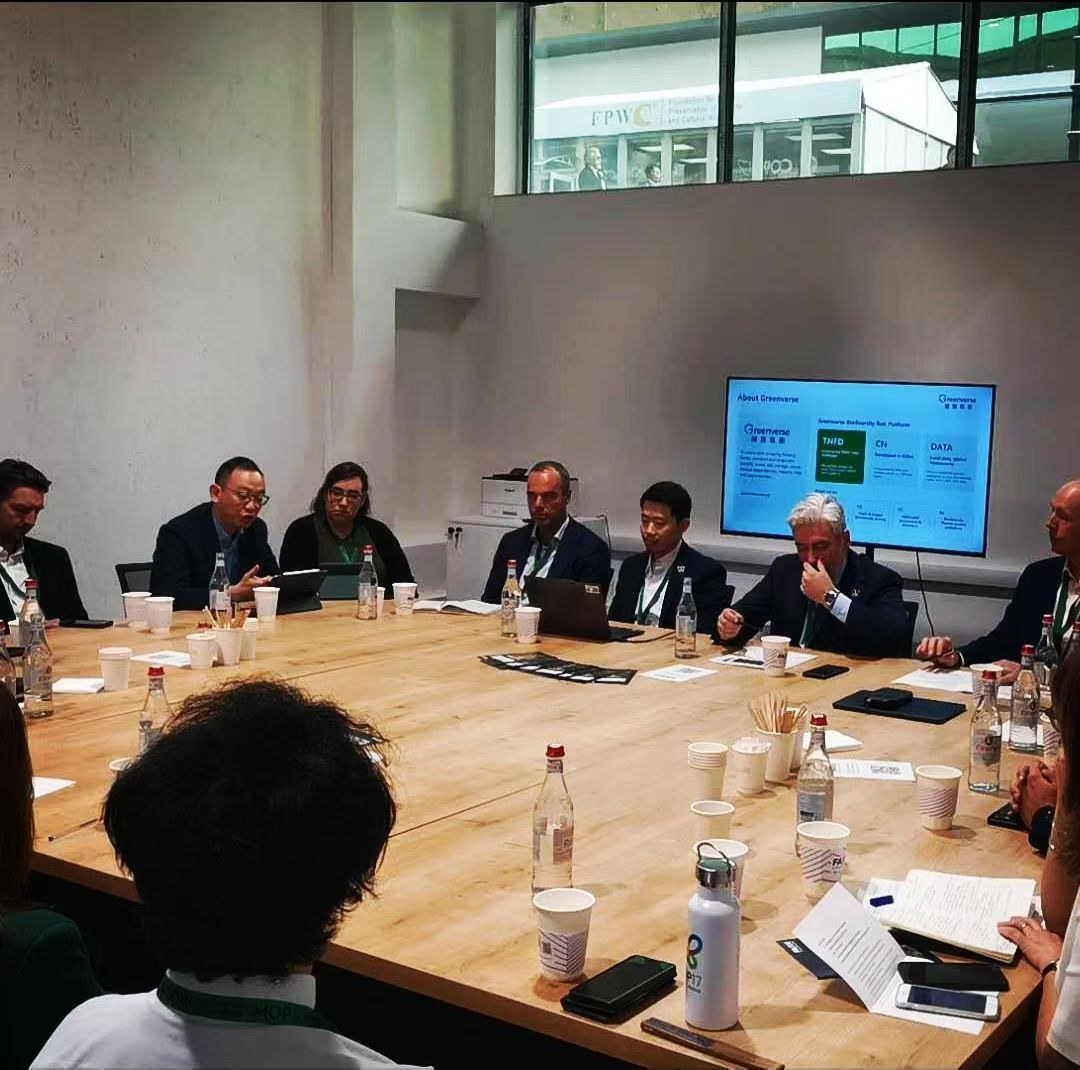
In discussions with representatives of international investment institutions, Du noted three questions that recurred — and that he regards as the most valuable takeaway from the briefing:
[Comparability and credibility of data] Definitions of nature-related data vary across jurisdictions and sectors. Investors need indicators that are comparable, traceable and verifiable rather than qualitative statements framed differently by each issuer. Site-level information and multi-source cross-validation therefore become infrastructure.
[Quantifying financial materiality] How dependencies and impacts on nature transmit into operating costs, supply-chain stability, asset valuation and credit risk is the question investors care about most — and one of the hardest to standardise.
[Integration into existing workflows] However sound an assessment, it cannot drive sustained management action unless it fits existing credit approval, investment review and post-investment monitoring systems. Assessment information has to be reusable, trackable and exportable.
These questions, Du observed, are shared globally. The distinctive feature of China's market is that listed companies, financial institutions and nature-tech platforms are advancing along the same chain at the same time, creating the conditions for a complete loop from data and assessment to decision applications.
04 | Bringing the exchange back into the product
"The briefing felt like a demand-side check on our assumptions," Du said. "The three questions investors kept asking are precisely where we have been concentrating our product work." In November 2026 Greenverse released Version 3.0 of its Nature & Biodiversity Risk Management Platform. Following the TNFD LEAP v2.0 assessment approach and informed by the organisational management logic of ISO 17298:2025, Platform 3.0 organises its capabilities across three layers — assessment foundation, analysis and decisions, and application and assurance: from site and spatial information management and dependency and impact assessment, through risk prioritisation and financial impact analysis, to biodiversity finance applications for financial institutions and linkage with third-party assurance. Read about Platform 3.0 →
Greenverse will continue to work on both data and AI, turning nature-related assessment from a one-off report into a reusable information foundation for decisions — supporting disclosure readiness at domestic listed companies, helping companies expanding overseas respond to the requirements of international customers and investors, and enabling financial institutions to bring nature factors into client and project analysis. The strong interest in Chinese practice, Du noted, reinforces a simple conviction: rigorous data and well-designed interfaces are the most substantive way for Chinese nature-tech solutions to take part in the global conversation.
About Greenverse
Greenverse is a Shanghai-based nature-tech and advisory company focused on ESG biodiversity and nature-related risk management. Combining international frameworks such as TNFD, SBTN and ISO 17298 with AI, remote sensing and China's ecological databases, Greenverse helps companies and financial institutions identify, assess and manage nature-related risks and opportunities. Learn more: greenverse.com.cn.
GET STARTED · NATURE RISK ASSESSMENT
Want to turn nature data into decisions? Start with a conversation.
Tell us your operating sites, sector and the management, disclosure or credit scenarios you care about. We will map an assessment path with you — no complete dataset needed before the first conversation.
Or scan our WeChat Work QR code on the contact page. We only use the information you choose to share to respond to your enquiry.