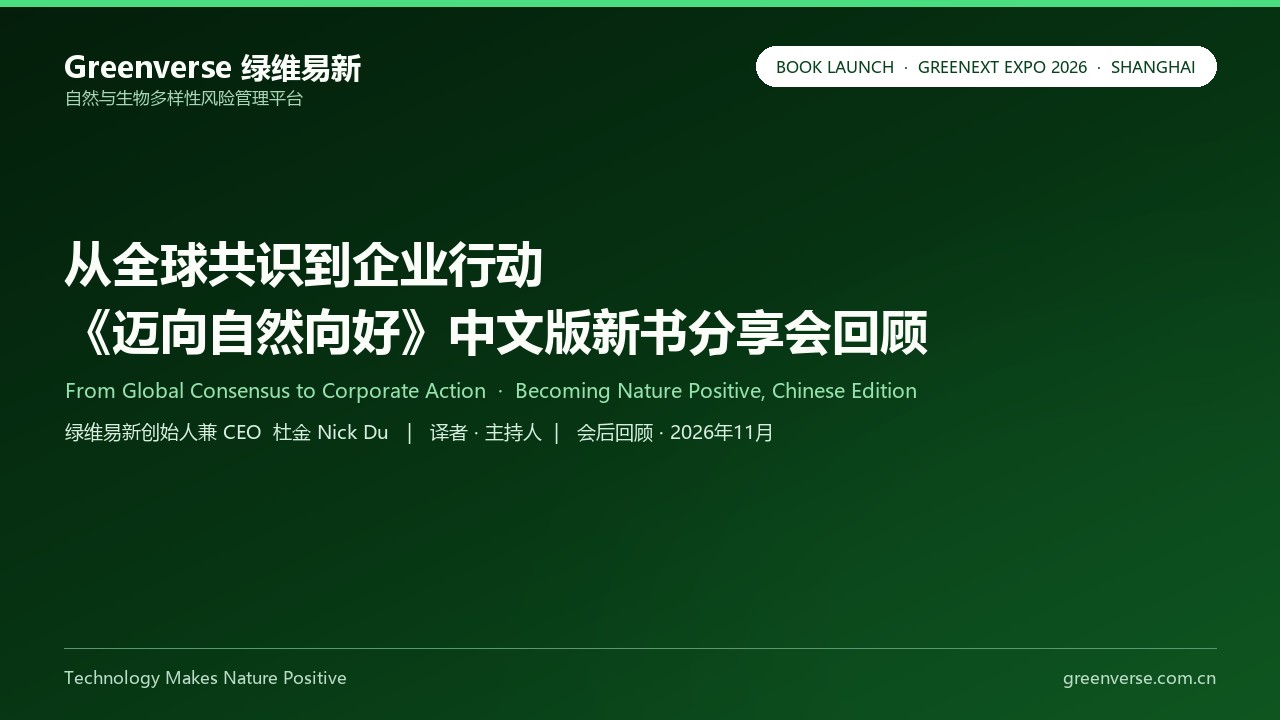
From Global Consensus to Corporate Action: Greenverse Founder Nick Du Reflects on the Chinese-Edition Launch of Becoming Nature Positive
At GREENEXT Expo 2026 in Shanghai, CNPA and Greenverse co-hosted the Chinese-edition book launch of Becoming Nature Positive. Founder and CEO Nick Du, translator of the Chinese edition, reflects on what it takes to turn a global framework into data, assessment and day-to-day business decisions.
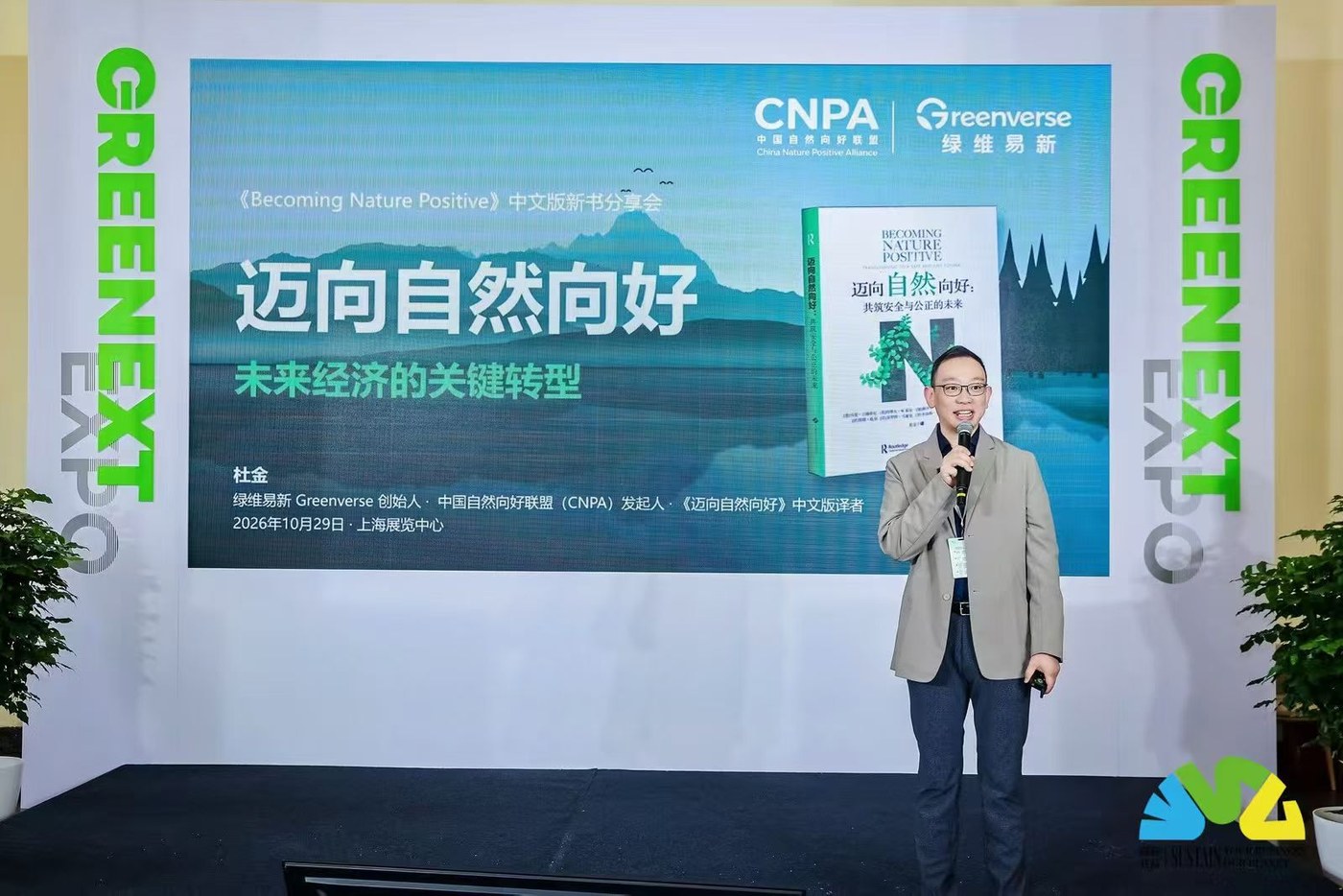
Shanghai, 29 October 2026 — Within the Nature Positive zone of GREENEXT Expo 2026, the China Nature Positive Alliance (CNPA) and Greenverse co-hosted the Chinese-edition book launch of Becoming Nature Positive: Transitioning to a Safe and Just Future, together with a roundtable on biodiversity practices of Chinese enterprises. Held at the Shanghai Exhibition Centre, the session was led by Nick Du, Founder and CEO of Greenverse and translator of the Chinese edition, who presented the book and moderated a conversation with representatives from manufacturing, textiles and insurance. The screen behind him read: "Becoming Nature Positive — the key transition for the future economy."
01 | Why this book: connecting "why" with "how"
Published by Routledge in June 2025, Becoming Nature Positive: Transitioning to a Safe and Just Future was written by seven international experts from science, business, finance and conservation. It was the first book to systematise the global nature-positive goal — halting and reversing nature loss by 2030 against a 2020 baseline and achieving full recovery by 2050, a mission embedded in the Kunming-Montreal Global Biodiversity Framework. The Chinese edition is published by Shanghai Scientific & Technical Publishers and translated by Nick Du. The motivation was straightforward: as the global consensus enters corporate strategy and financial decision-making, Chinese readers needed a complete account of the framework in their own language.
For a nature-tech company, however, the value of a book does not stop at explaining "why". A book offers direction and a roadmap; what companies and financial institutions face every day is a more concrete question — how to turn "nature" from a grand goal into a variable that can be located, assessed, disclosed and fed into operating and credit decisions. The first is consensus; the second is engineering. That is where this book launch was intended to land from the outset.
02 | From Beijing to Yerevan to Shanghai: one chain of questions
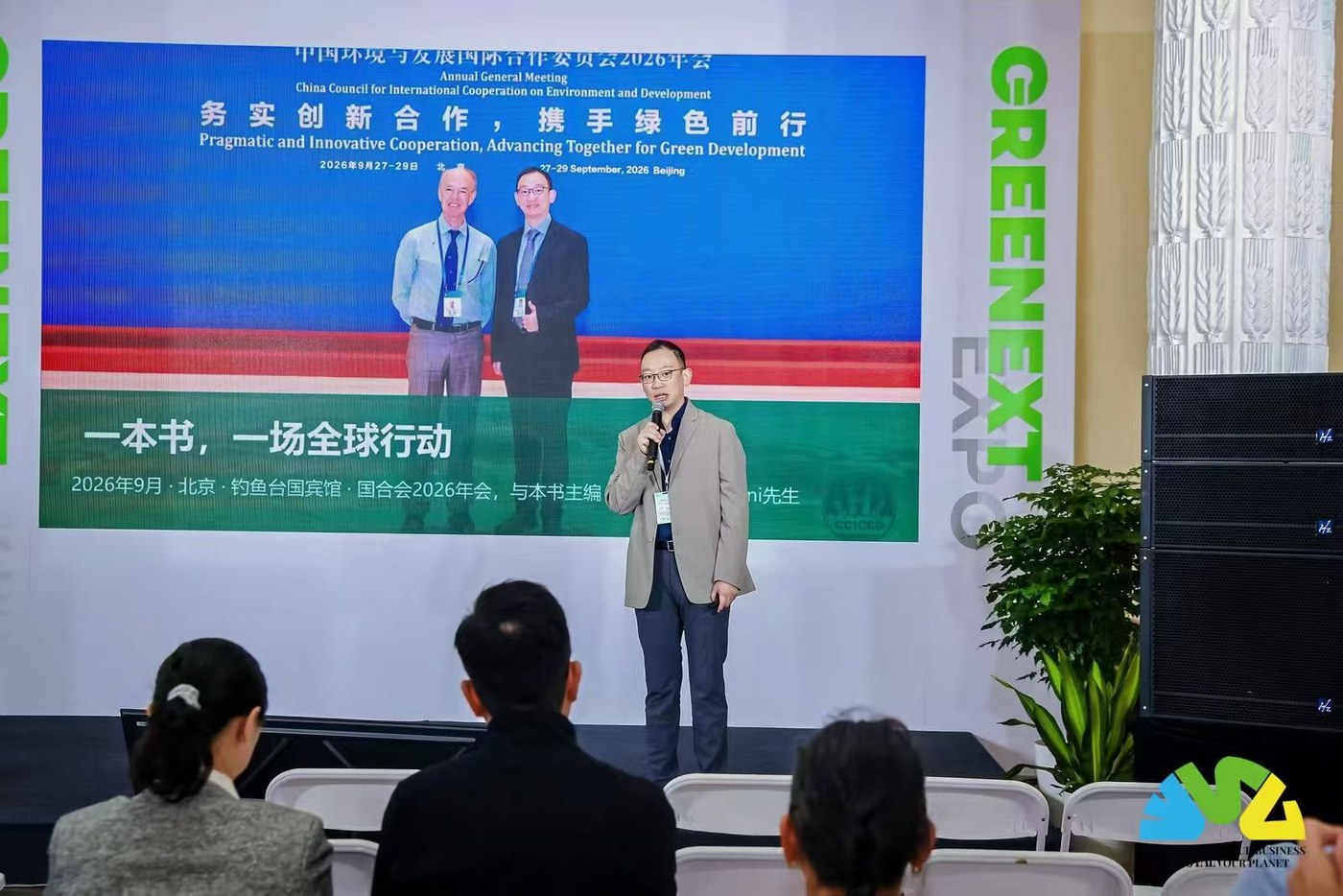
The book's itinerary happened to connect three conversations about nature positive in autumn 2026. In Beijing in September, the CCICED 2026 Annual Meeting placed the book in an international dialogue on environment and development under the banner "One book, one global movement". In Yerevan, Armenia, during CBD COP17 in October, Du joined the Standards & Disclosure segment of the Nature Positive Pavilion's "What's Next for the Nature Positive Agenda?", a PRI investor forum side event and an ESCAP×CBD regional workshop, discussing data, standards and capital with peers from around the world. On 29 October, back in Shanghai, the book was put in front of companies — and the conversation moved from agenda to practice.

In Yerevan, three questions kept coming back: how nature-related data can be made comparable, credible and verifiable across jurisdictions and sectors; how dependencies and impacts on nature can be quantified in financial terms; and how assessment results can be integrated into existing credit approval, investment review and risk management workflows. In Du's own post-conference reflection, the task was to work out "how nature risks can be calculated properly, and how capital can be steered towards nature-friendly outcomes". Those questions travelled from the international conference rooms to the stage in Shanghai.
03 | The roundtable: three sectors, three cross-sections of data
The 60-minute roundtable broke the book's chapters on the role of business and the redirection of financial flows into very specific questions. Representatives from manufacturing, textile supply chains and insurance correspond to three different cross-sections of data: operating sites and their surroundings, upstream raw materials and traceability, and the transmission of nature-related risk through financial products and portfolios. They look disparate, yet they point to a single chain — site-level data, dependency and impact assessment, risk prioritisation and financial impact, disclosure and decisions.
That was the point the session most wanted to convey: nature positive is neither a report nor a slogan, but a data chain that has to connect with systems companies already run. A book can set the direction; making that direction operational requires tools, definitions and interfaces. Every industry case discussed at the roundtable came back to the same three questions — where does the data come from, how is it verified, and which workflow does it enter.
04 | Takeaways and next steps: turning a framework into reusable tools
Greenverse's Biodiversity Risk Management Platform is listed in the TNFD Global Official Tools Catalogue. Built on the LEAP approach, it supports site-level assessment, multi-source ecological data validation and reporting. In November 2026 Greenverse released Version 3.0 of its Nature & Biodiversity Risk Management Platform, organising capabilities across three layers — assessment foundation, analysis and decisions, and application and assurance: from site and spatial information management and dependency and impact assessment, through risk prioritisation and financial impact analysis, to applications for financial institutions and linkage with third-party assurance. In short, it turns the book's roadmap into an information foundation that companies can use again and again. Read about Platform 3.0 →
From the "coming soon" announcement of the Chinese edition, through Beijing and Yerevan, to this hour at the Shanghai Exhibition Centre, the arc looks like a single sentence from a founder's perspective: the global framework is clear enough; what matters next is who can turn it into executable, verifiable, reusable everyday actions. If you are wondering which operating site, which supply chain or which decision scenario to start with, we would be glad to talk — a conversation about an assessment path is a perfectly good place to begin.
About Greenverse
Greenverse is a Shanghai-based nature-tech and advisory company focused on ESG biodiversity and nature-related risk management. Combining international frameworks such as TNFD, SBTN and ISO 17298 with AI, remote sensing and China's ecological databases, Greenverse helps companies and financial institutions identify, assess and manage nature-related risks and opportunities. Learn more: greenverse.com.cn.
GET STARTED · NATURE RISK ASSESSMENT
Want to turn a global framework into a decision? Start with a conversation.
Tell us your operating sites, sector and the management, disclosure or credit scenarios you care about. We will map an assessment path with you — no complete dataset needed before the first conversation.
Or scan our WeChat Work QR code on the contact page. We only use the information you choose to share to respond to your enquiry.